Skip to content

Posts from the ‘4 star reviews’ Category

Non 1001 Book Review: After Dark Haruki Murakami

after dark

After Dark by Haruki Murakami
Published in: 2004
Translated from Japanese by Jay Rubin
Reviewed by: Book Worm
Rating: 4 stars
Find it here: After Dark

Synopsis: (from the Back Cover): Eyes mark the shape of the city

The midnight hour approaches in an almost-empty diner. Mari sips her coffee and reads a book, but soon her solitude is disturbed: a girl has been beaten up at the Alphaville hotel, and needs Mari’s help.

Meanwhile Mari’s beautiful sister Eri lies in a deep, heavy sleep that is ‘too perfect, too pure’ to be normal; it has lasted for two months. But tonight as the digital clock displays 00:00, a hint of life flickers across the television screen, even though it’s plug has been pulled out.

Strange nocturnal happenings, or a trick of the night?

Review: If you read our featured author post you will know that I love Murakami’s writing and this book was no exception. From the moment I read the back cover, I had a happy warm feeling in my tummy. I knew this was going to be a good read. The front cover just calls out to you “read me, read me.” The only problem with this book is that it is short. I could have stayed wandering around Tokyo at night much longer than the time Murakami allowed me.

From the opening lines of the book we, the readers, are told that we are voyeurs. We can watch what happens in the city. We can zoom in on bits that interest us, but we cannot get involved. We cannot influence anything.  We cannot be heard and we are entirely neutral.

The book is set on a midwinter’s night between the hours of 11:56pm and 6:52am in Tokyo. It revolves around 3 central characters: the beautiful Eri who has decided to sleep and not wake up; her intelligent sister Mari who cannot sleep; and Takahashi a young musician who provides a link between the 2 sisters.

While Eri sleeps her beautiful sleep, Mari stays awake in the city where she encounters Takahashi in a Denny’s restaurant. Their meeting leads her to be pulled into the life of the “Night People.” Night people are those who are more at home after the sun has gone down — the insomniacs, prostitutes, and others who prefer the night.

While there is some action in this book, it’s more about feelings and perceptions than about plot development. There is violence and vengeance, and in true Murakami style there are mystical and magical moments and cats!! How do you know you are reading a Murakami? Because there are always cats.

This is a stylized book and I can easily see it being made into a noir film as the story really lends itself to the visual.

For those who like a proper ending with all the loose ends tied up, this is not the book for you (nor is any other Murakami book). There are several mysterious events that are not explained and are just left dangling when the sun rises. Murakami has created a place that exists only after dark and so until the next time the sun sets the mysteries will have to stay mysteries.

Want to try if for yourself? You can find it here: After Dark

We want to hear from you. Have you read this book? What did you think? Do you like Murakami’s books?

1001 Book Review: Transit Anna Seghers

transit

Transit by Anna Seghers
Published in: 1944
Reviewed by Jen & Book Worm
Find it here:Transit (New York Review Books Classics)

Synopsis (from Amazon): Anna Seghers’s Transit is an existential, political, literary thriller that explores the agonies of boredom, the vitality of storytelling, and the plight of the exile with extraordinary compassion and insight.
Read more

The Color of Our Sky by Amita Trasi

color of our sky

The Color of Our Sky by Amita Trasi
Publisher: Bloomhill Books
Release Date: June 30, 2015
Reviewed by: Jen
Rating: 4 stars
Pre-Order the book here: The Color of our Sky

This ARC was provided by Bloomhill Books (via NetGalley) in exchange for an honest review.

The Color of Our Sky is a beautifully rendered and emotionally powerful book. Set primarily in Mumbai, India, the novel tells the stories of Tara and Mukta, two childhood friends from vastly different social backgrounds whose lives are forever changed by a series of tragic events in their childhood. Mukta is a lower caste girl, the daughter of a temple prostitute, who is destined to the same fate as her mother. When her mother dies, Tara’s father rescues her from her fate by bringing her home to live with his family. The two girls become close until tragedy strikes again and Mukta is stolen from their house and seemingly lost forever. Tara and her father move to America and she grows up believing that Mukta is dead, carrying guilt for her role Mukta’s abduction. After her father’s death, Tara discovers that her father had lied to her about Mukta. Vowing to return to India and find Mukta, Tara embarks on a journey that takes her deep into the world of human sex trafficking.

The novel is told from the alternating perspectives of Tara and Mukta and the narratives weave back and forth in time spanning from the 1980s through present day. As the stories shift back and forth, we learn the fate of Mukta and the truth about the events that led up to her abduction. Heart-breaking but also inspiring, the novel highlights the resilience of the human spirit and the strength of human connection (friendship and family) to overcome unspeakable adversity.
Read more

Read Around the World: Czech Republic

900px-Flag_of_the_Czech_Republic

The next stop on our world tour of reading is the Czech Republic! This month’s choice was inspired by my recent trip to Prague along with my recent bout of reading Czech authors. Prague was one of the most beautiful cities I have ever visited. I was also fortunate enough to have time to visit a few locations outside of Prague including Český Krumlov in the Southern Bohemian Region and Terezín, the sad location of a concentration camp. I hope you enjoy some of my photos (at the bottom of this post). Next week, I’ll continue the Czech theme with our featured author post: Kafka.

Read more

1001 Book Review: Shroud John Banville

shroud

Shroud by John Banville
Published in: 2002
Awards: Man Booker Prize Nominee for Longlist (2002)
Reviewed by: Book Worm and Jen
Find it here:Shroud

Synopsis (from Amazon): One part Nietzsche, one part Humbert Humbert, and a soupcon of Milton’s Lucifer, Axel Vander, the dizzyingly unreliable narrator of John Banville’s masterful new novel, is very old, recently widowed, and the bearer of a fearsome reputation as a literary dandy and bully. A product of the Old World, he is also an escapee from its conflagrations, with the wounds to prove it. And everything about him is a lie.

Now those lies have been unraveled by a mysterious young woman whom Vander calls “Miss Nemesis.” They are to meet in Turin, a city best known for its enigmatic shroud. Is her purpose to destroy Vander or to save him—or simply to show him what lies beneath the shroud in which he has wrapped his life? A splendidly moving exploration of identity, duplicity, and desire, Shroud is Banville’s most rapturous performance to date.

Read more

1001 Book Review: Murder Must Advertise by Dorothy Sayers

murdermustadvertise

Murder Must Advertise by Dorothy Sayers
Published in: 1933
Reviewed by: Jen
Rating: 4 stars
Find it here:Murder Must Advertise

I’ve always associated cozy mysteries with the types of mystery books that appeal to either children or older ladies with lots of cats. Read more

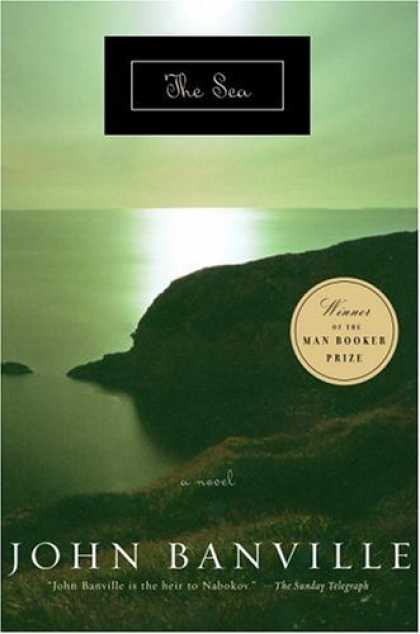
1001 Book Review: The Sea by John Banville

thesea

The Sea by John Bangle
Awards:  Booker Prize 2005
Reviewed by: Jen
Rating: 4.5 stars
Find it here:The Sea

Every once in a while you encounter a book with writing so beautiful that it makes you never want to return to the world of “ordinary” writing. The Sea was one of those books.

The Sea is a seemingly simple, but in essence rather complicated novel about loss, grief, memory, and regret. The protagonist is an aging man who, after losing his wife to cancer, rents a room at a boardinghouse that played a significant role in his childhood. Banville takes his time in letting the reader discover what happened to Banville during his childhood. He glides back and forth in time, weaving in two significant life events. The reliability of the narrator is brought into question as memory is unreliable and impacted by the experience of loss and grief.

I make myself think of her, I do it as an exercise. She is lodged in me like a knife and yet I am beginning to forget her. Already the image of her that I hold in my head is fraying, bits of pigments, flakes of gold leaf, are chipping off. Will the entire canvas be empty one day? I have come to realize how little I knew her, I mean how shallowly I knew her, how ineptly. I do not blame myself for this. Perhaps I should. Was I too lazy, too inattentive, too self-absorbed? Yes, all of those things, and yet I cannot think it is a matter of blame, this forgetting, this not-having-known. I fancy, rather, that I expected too much, in the way of knowing. I know so little of myself, how should I think to know another?

This was my first introduction to Banville’s writing and it blew me away. I loved the beautiful prose and exquisitely crafted sentences. The story is slow and at times meandering and directionless. The narrator skips around in time and the shifts in time make it difficult to follow. I can see why some people were bored (as indicated by goodreads reviews for this book) by the slow pace of the book and the confusing shifts in time, but I found the writing so beautiful and captivating that I remained engaged throughout. As a psychologist, I was also captivated by the way the author made memories blend to provide a more complete understanding of the narrator’s “current” emotional state. The Sea is a psychologically and emotionally complex book that is brought to greater heights by the truly gorgeous albeit highly dense writing.

The book is not for everyone. There is no fast-moving plot and the language and sentence construction is complex. I admittedly had to pull out the dictionary on several occasions. Serious, literary fiction readers will appreciate this book for the beauty and complexity of the writing. That is not to say that the casual reader won’t enjoy this book, but that it is a book that requires a certain degree of investment – a willingness to dig a little deeper below the surface of plot line and think more deeply about the themes and issues raised by the author. Banville also references numerous literary works (both directly and indirectly) and while you can still appreciate the book without this background knowledge, the book is more enjoyable if you are able to recognize these references. I highly recommend this book!

Quotes I enjoyed:

Happiness was different in childhood. It was so much then a matter simply of accumulation, of taking things – new experiences, new emotions – and applying them like so many polished tiles to what would someday be the marvelously finished pavilion of the self.

Yes, this is what I thought adulthood would be, a kind of long Indian summer, a state of tranquility, of calm incuriousness, with nothing left of the barely bearable raw immediacy of childhood, all the things solved that had puzzled me when I was small, all mysteries settled, all questions answered, and the moments dripping away, unnoticed almost, drip by golden drip, toward the final, almost unnoticed, quietus.”

Life, authentic life, is supposed to be all struggle, unflagging action and affirmation, the will butting its blunt head against the world’s wall, suchlike, but when I look back I see that the greater part of my energies was always given over to the simple search for shelter, for comfort, for, yes, I admit it, for coziness. This is a surprising, not to say shocking, realization. Before, I saw myself as something of a buccaneer, facing all-comers with a cutlass in my teeth, but now I am compelled to acknowledge that this was a delusion. To be concealed, protected, guarded, that is all I have ever truly ever wanted, to burrow down into a place of womby warmth and cower there, hidden from the sky’s indifferent gaze and the air’s harsh damagings. That is why the past is just such a retreat for me, I go there eagerly, rubbing my hands and shaking off the cold present and the colder future. And yet, what existence, really, does it have, the past? After all, it is only what the present was, once, the present that is gone, no more than that. And yet.”

There are times, they occur with increasing frequency nowadays, when I seem to know nothing, when everything I know seems to have fallen out of my mind like a shower of rain, and I am gripped for a moment in paralyzed dismay, waiting for it all to come back but with no certainty that it will.

Want to try it out for yourself? You can find it here:The Sea

In 2013 the book was made into a movie. You can see the trailer below.

We want to hear from you! Have you seen the movie or read the book? What did you think?

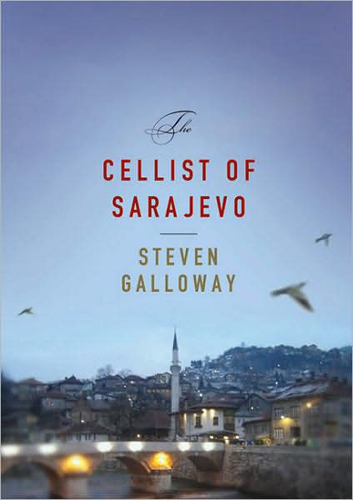
The Cellist of Sarajevo by Steven Galloway

cellist

The Cellist of Sarajevo by Steven Galloway
Published in: 2008
Reviewed by: Jen
Rating:4 stars
Find it here:The Cellist of Sarajevo

The Cellist of Sarajevo was inspired by events during the siege of Sarajevo in the 1990s. When a mortar round kills twenty-two people waiting in line for bread, a cellist in the symphony orchestra engages in an act of defiance against the perpetrators: he vows to play Albinoni’s Adagio in G minor every day for 22 days to honor the victims. This moment sets the backdrop for a novel in which Galloway weaves the primary stories of three people living in Sarajevo at the time of the siege. Arrow is a woman whose decision to accept an assignment as a sniper killing soldiers starts to change her in numerous ways, questioning her ultimate humanity. Kegan is a young family man whose frequent trips to gather clean water for his family puts him in harm’s way on a regular basis. Degan is an older man with a wife and child who moved to Italy before the city was closed off.  He encounters an old friend who forces him to question his life before the war.
Read more

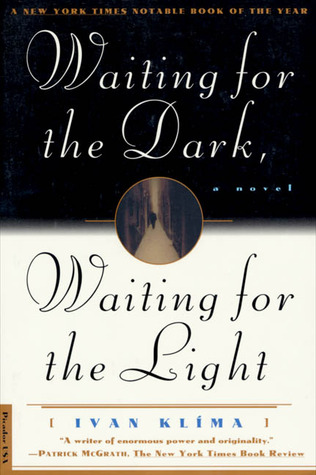
1001 Book Review: Waiting for the Dark, Waiting for the Light

waiting for the dark

Waiting for the Dark, Waiting for the Light by Ivan Klima
First Published in: 1994
Original Language: Czech
Reviewed by: Jen
Rating: 4 stars
Find it here: Waiting for the Dark, Waiting for the Light: A Novel

I read Waiting for the Dark, Waiting for the Light about a month ago but have delayed in writing this review because I found the book rather complicated and it required some reflection on my part. The story is set in Czechoslovakia during and after the velvet revolution of 1989. The protagonist, Pavel, is a middle-aged camera man who is living with his girlfriend, her son, and her ex-husband. As a young man, Pavel tried to escape his repressive regime but when we meet him, he is working for a state-run television network producing state sponsored propaganda news. In his spare time Pavel dreams about the movies he wants to make. The novel alternates between sections of Pavel’s real life and his life as imagined by the movies he wants to make.

I don’t want to say too much more about the plot so you can enjoy it for yourself. This was a pretty dark and bleak read but with humor injected throughout. There is a touch of surrealism throughout the book which makes it a more interesting read. Klima does a wonderful job capturing the atmosphere of ordinary people living in a repressive regime while at the same time blurring lines between the reality and fiction. I do have to admit that I was really confused for the majority of the book. It wasn’t until about 3/4 of the way in that I realized how the book was structured. This was a problem for me since the character names overlapped between versions with facts changing throughout. Even after realizing that parts of the book were Pavel’s imagined film, the boundaries were never crystal clear and had me questioning which events were real and which were imagined.

Another interesting element about this book was that it covered a period of transition between the old and new regime and it highlighted the feeling of being stuck between two different eras. His characters are trapped in a system that only allows for self-defeat. At one point the protagonist states:

The system never allowed you to win, and so it saved you from defeat as well.

Characters feel impotent and turn to dreams and fantasy in order to imagine how their lives could have been different.

Despite it’s rather complicated message, plot, and structure, it is a book that is easy to read and doesn’t feel overly dense (unlike many other Eastern European classics). I highly recommend this book, particularly for those readers who enjoy fiction with ties to political realities.

Additional quotes

A picture was a motionless record of motion. An arrested representation of life. A picture was the kiss of death pretending to possess immutability.

You can rule with a firm hand, or you can rule through consensus. Those with neither the strength nor the courage for firmness take refuge in the belief that they can remain somewhere in between. But that is an illusion.

Life is waiting for the light, not for the dark,’ she said. ‘My Indian teacher told me that. He was blind.’

It was like a spider’s web with a lot of spiders in it, not just one. They lay in wait for you at every corner of the web. Once you got caught in it you couldn’t get free. And they didn’t suck your blood right away, they’d just very slowly wind you into their web.

 Want to try it for yourself? Find it here: Waiting for the Dark, Waiting for the Light: A Novel

1001 Book Review: The Lost Honor of Katharina Blum by Heinrich Böll

kATHERINAThe Lost Honour of Katherina Blum by Heinrich Böll
First Published in: 1974
Original language: German
Find it/Buy it here: The Lost Honor of Katharina Blum (Penguin Classics)

Synopsis (from Amazon): In an era in which journalists will stop at nothing to break a story, Henrich Böll’s The Lost Honor of Katharina Blum has taken on heightened relevance. A young woman’s association with a hunted man makes her the target of a journalist determined to grab headlines by portraying her as an evil woman. As the attacks on her escalate and she becomes the victim of anonymous threats, Katharina sees only one way out of her nightmare. Turning the mystery genre on its head, the novel begins with the confession of a crime, drawing the reader into a web of sensationalism, character assassination, and the unavoidable eruption of violence.

Jen’s Review:
Rating: ★★★★
Katharina Blum is an upstanding young woman who seems to be the model citizen but she just happens to have murdered a man. Don’t worry, this is not a spoiler! The book begins with the disclosure of the murder and works back and forth in time to uncover the events that led up to the murder. Böll poses the question of how ordinary people may be driven into acting in violent ways. The novel is a short, quick, and engaging read that probes into the responsibility of the media in creating stories that impact the lives of people in a harmful way.

I really enjoyed the book. The narrative style was unique and engaging and it resembled an investigative journalism piece with seemingly objective reporting. The story was pieced together with flashbacks, written statements and transcripts, lists, and commentary from the narrator, some of which was humorous. The book raises interesting questions about a) what the role of the media is and should be, b) which sorts of information should be private/public, and c) how media and social opinion can impact the lives of individuals. Very relevant to today’s society and in an interesting perspective on journalistic ethics and sensationalism.

I find Böll to be an extremely skilled author who is remarkably adept at capturing social issues in a believable way. His ability to craft complex characters and to understand the human psyche is impressive. He won the Nobel Prize for literature in 1972 and in my opinion is a must-read author.

Book Worm’s Review:
Rating:★★★★
Opening with the confession of Katharina to the murder of a journalist in her flat,  this novel presents the events that lead to the murder and asks the reader to decided who committed the biggest crime:  Katharina or the people whose actions drove her to it?

This novel, told by a detached narrator, contains a warning about believing everything you read or hear in the news. It illustrates how lives can be destroyed by the manipulative actions of both the media and those with a vested interest in keeping the real story hidden.

Katharina is an ordinary woman, a house keeper by profession whose life is destroyed by being misrepresented in the media, her only crime falling in love with the wrong man.

This is a powerful read and is still relevant today. This morning I was watching a news article about Jeremy Clarkson. The report claimed he had said that being fired from Top Gear was “worse than losing a child.” What he actually said was “Top Gear was my baby, I am lost without it” or words to that effect. I find that kind of manipulation and misrepresenting reprehensible and entirely unnecessary.

Have you read this book? What did you think? Have you read others by Boll? Share your thoughts with us.

Want to try it for yourself? You can find a copy here: The Lost Honor of Katharina Blum (Penguin Classics)