The next stop on our world tour of reading is the Czech Republic! This month’s choice was inspired by my recent trip to Prague along with my recent bout of reading Czech authors. Prague was one of the most beautiful cities I have ever visited. I was also fortunate enough to have time to visit a few locations outside of Prague including Český Krumlov in the Southern Bohemian Region and Terezín, the sad location of a concentration camp. I hope you enjoy some of my photos (at the bottom of this post). Next week, I’ll continue the Czech theme with our featured author post: Kafka.
Shroud by John Banville
Published in: 2002
Awards: Man Booker Prize Nominee for Longlist (2002)
Reviewed by: Book Worm and Jen
Find it here:Shroud
Synopsis (from Amazon): One part Nietzsche, one part Humbert Humbert, and a soupcon of Milton’s Lucifer, Axel Vander, the dizzyingly unreliable narrator of John Banville’s masterful new novel, is very old, recently widowed, and the bearer of a fearsome reputation as a literary dandy and bully. A product of the Old World, he is also an escapee from its conflagrations, with the wounds to prove it. And everything about him is a lie.
Now those lies have been unraveled by a mysterious young woman whom Vander calls “Miss Nemesis.” They are to meet in Turin, a city best known for its enigmatic shroud. Is her purpose to destroy Vander or to save him—or simply to show him what lies beneath the shroud in which he has wrapped his life? A splendidly moving exploration of identity, duplicity, and desire, Shroudis Banville’s most rapturous performance to date.
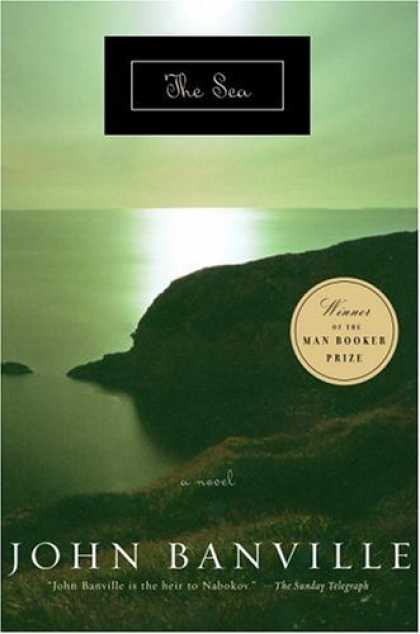
The Sea by John Bangle
Awards: Booker Prize 2005
Reviewed by: Jen
Rating: 4.5 stars
Find it here:The Sea
Every once in a while you encounter a book with writing so beautiful that it makes you never want to return to the world of “ordinary” writing. The Sea was one of those books.
The Sea is a seemingly simple, but in essence rather complicated novel about loss, grief, memory, and regret. The protagonist is an aging man who, after losing his wife to cancer, rents a room at a boardinghouse that played a significant role in his childhood. Banville takes his time in letting the reader discover what happened to Banville during his childhood. He glides back and forth in time, weaving in two significant life events. The reliability of the narrator is brought into question as memory is unreliable and impacted by the experience of loss and grief.
I make myself think of her, I do it as an exercise. She is lodged in me like a knife and yet I am beginning to forget her. Already the image of her that I hold in my head is fraying, bits of pigments, flakes of gold leaf, are chipping off. Will the entire canvas be empty one day? I have come to realize how little I knew her, I mean how shallowly I knew her, how ineptly. I do not blame myself for this. Perhaps I should. Was I too lazy, too inattentive, too self-absorbed? Yes, all of those things, and yet I cannot think it is a matter of blame, this forgetting, this not-having-known. I fancy, rather, that I expected too much, in the way of knowing. I know so little of myself, how should I think to know another?
This was my first introduction to Banville’s writing and it blew me away. I loved the beautiful prose and exquisitely crafted sentences. The story is slow and at times meandering and directionless. The narrator skips around in time and the shifts in time make it difficult to follow. I can see why some people were bored (as indicated by goodreads reviews for this book) by the slow pace of the book and the confusing shifts in time, but I found the writing so beautiful and captivating that I remained engaged throughout. As a psychologist, I was also captivated by the way the author made memories blend to provide a more complete understanding of the narrator’s “current” emotional state. The Sea is a psychologically and emotionally complex book that is brought to greater heights by the truly gorgeous albeit highly dense writing.
The book is not for everyone. There is no fast-moving plot and the language and sentence construction is complex. I admittedly had to pull out the dictionary on several occasions. Serious, literary fiction readers will appreciate this book for the beauty and complexity of the writing. That is not to say that the casual reader won’t enjoy this book, but that it is a book that requires a certain degree of investment – a willingness to dig a little deeper below the surface of plot line and think more deeply about the themes and issues raised by the author. Banville also references numerous literary works (both directly and indirectly) and while you can still appreciate the book without this background knowledge, the book is more enjoyable if you are able to recognize these references. I highly recommend this book!
Quotes I enjoyed:
Happiness was different in childhood. It was so much then a matter simply of accumulation, of taking things – new experiences, new emotions – and applying them like so many polished tiles to what would someday be the marvelously finished pavilion of the self.
Yes, this is what I thought adulthood would be, a kind of long Indian summer, a state of tranquility, of calm incuriousness, with nothing left of the barely bearable raw immediacy of childhood, all the things solved that had puzzled me when I was small, all mysteries settled, all questions answered, and the moments dripping away, unnoticed almost, drip by golden drip, toward the final, almost unnoticed, quietus.”
Life, authentic life, is supposed to be all struggle, unflagging action and affirmation, the will butting its blunt head against the world’s wall, suchlike, but when I look back I see that the greater part of my energies was always given over to the simple search for shelter, for comfort, for, yes, I admit it, for coziness. This is a surprising, not to say shocking, realization. Before, I saw myself as something of a buccaneer, facing all-comers with a cutlass in my teeth, but now I am compelled to acknowledge that this was a delusion. To be concealed, protected, guarded, that is all I have ever truly ever wanted, to burrow down into a place of womby warmth and cower there, hidden from the sky’s indifferent gaze and the air’s harsh damagings. That is why the past is just such a retreat for me, I go there eagerly, rubbing my hands and shaking off the cold present and the colder future. And yet, what existence, really, does it have, the past? After all, it is only what the present was, once, the present that is gone, no more than that. And yet.”
There are times, they occur with increasing frequency nowadays, when I seem to know nothing, when everything I know seems to have fallen out of my mind like a shower of rain, and I am gripped for a moment in paralyzed dismay, waiting for it all to come back but with no certainty that it will.
Want to try it out for yourself? You can find it here:The Sea
In 2013 the book was made into a movie. You can see the trailer below.
We want to hear from you! Have you seen the movie or read the book? What did you think?
The Kindly Ones by Jonathan Little
Published in: 2006
Original Language: French
Awards: Prix Goncourt 2006 Reviewed by: Book Worm Rating:★★★ Find it here: The Kindly Ones
Amazon Synopsis: Dr Max Aue is a family man and owner of a lace factory in post-war France. He is an intellectual steeped in philosophy, literature, and classical music. He is also a former SS intelligence officer and cold-blooded assassin. He was an observer and then a participant in Nazi atrocities on the Eastern Front, he was present at the siege of Stalingrad, at the death camps, and finally caught up in the overthrow of the Nazis and the nightmarish fall of Berlin.
His world was peopled by Eichmann, Himmler, Göring, Speer and, of course, Hitler himself.
Max is looking back at his life with cool-eyed precision; he is speaking out now to set the record straight. Read more
The 39 Steps by John Buchan
First Published in: 1915
Reviewed by: Jen and Book Worm
Find it/buy it here (free on kindle): The Thirty-Nine Steps
Synopsis (from Goodreads): Richard Hannay’s boredom with London society is soon relieved when the resourceful engineer from South Africa is caught up in a web of secret codes, spies, and murder on the eve of WWI. When a neighbor is killed in his flat, Richard, suspected, decodes the journal, runs to the wilds of his native Scotland in disguises and local dialects, evades Germans and officials.
Book Worm’s Review
Rating: ★★★
Credited as one of the earliest spy novels and set in 1914 before the outbreak of WWI this is the story of Robert Hannay. Hannay, who recently moved to London from Rhodesia is finding life rather dull until the mysterious Scudder turns up on his doorstep and tells him about a German conspiracy to assassinate a key public figure.
When Hannay comes home to find Scudder murdered in his flat, he realizes he is being set up for murder. Instead of trying to explain things to the police and clear his name, he decides to continue Scudder’s work and escapes London for the wilds of Scotland.
Told entirely in the first person, this is a fast-moving adventure story. The only problem is that Hannay is unbelievable as a character. He is too skilled at everything. Nothing fazes him and he is a one man spy network. While this makes for an exciting read, you do need to suspend your disbelief and just go along for the ride.
Jen’s Review
Rating: ★★★
The 39 Steps is a fast-paced and entertaining, but completely unbelievable man-on-the-run, spy novel. Richard Hannay is bored with society life and is saved from his boredom just in the nick of time by a stranger who turns up in his apartment only to trigger a series of increasingly unbelievable events.
In many ways, Hannay is the like the movie version of James Bond (the book version of Bond being much more believable), but without all the spy training — he just happens to be naturally brilliant at handling explosives, disguising himself, decoding military secrets. Mix in a little Sherlock Holmes and you have Richard Hannay. Reading this book, you can’t help but see how it would translate into a great movie. In fact, several film translations exist, including a 1935 Hitchcock version.
The writing style is rather sparse and typical of the dime novel genre. Buchan worked for the British War Propaganda Bureau and this book, originally published as a magazine serial, was highly popular among men in the trenches during WWI. The Guardian listed 39-Steps as one of the 100 Best novels and Boxall considers it to be one of the 1001 books to read before you die. It’s a relatively short and entertaining read — if you don’t require realistic scenarios in your novels. It’s worth reading simply because of its contribution to the genre.
Want to try it for yourself? Find it (for free on Amazon) here: The Thirty-Nine Steps
Have you read this book? If so, what did you think?
The next stop on our world tour of reading is India! This month, we have a special guest contributor: Aarti. Aarti is from Pune, India and will be sharing some fun facts about her country, Indian literature, and her personal recommendations for books to help immerse you in your “travels.” Book Worm and I will chime in with our pick of the month and our reviews for that book.
After reading and hating Henderson the Rain King, I approached The Victim with a sense of dread. I read this book as part of a reading challenge. Henderson the Rain King is one of those books that made me mad. I resented the author for putting me through that awful experience and desperately wanted the lion to just go ahead and eat Henderson, so I could be put out of my misery. I know lots of people love Bellow but he strikes me as a pretentious author who enjoys battering readers over the head with his philosophical musings.
So I approached The Victim with a sense of apprehension and resentment for the fact that I had pulled this particular author for one of my challenge books. Expectations, whether they be negative or positive, influence how we evaluate books. So, when I didn’t hate this one, I was pleasantly surprised and almost wanted to write a glowing 5-star review. However, had I not been basing my rating on my prior experience, this would not be a 5-star rating for me. So in an effort to be somewhat more objective, I settled on a 3-star rating.
Have you ever noticed how some books seem to drive a wedge between people? You check the reviews and find almost no middle-of-the-road ratings. Instead people either seem to love it or hate it. Well, welcome to the Love it or Hate it post category! Each month, we’ll pick one book to review and two contributors will battle it out to convince you to pick it up or throw it out. Last month we discussed The Brief and Wondrous Life of Oscar Waoand for the first time we ended up with a tie. Many thanks to Nicole D and Charisma for their wonderful reviews.
This month we will be discussing: Gone with the Wind by Margaret Mitchell. The names of our two contributors will be revealed after voting closes! Please make sure to vote for this month’s book even if you haven’t read the book! The poll is at the bottom of this post.
Synopsis (modified from Amazon.com): Widely considered The Great American Novel, and often remembered for its epic film version, Gone With the Wind explores the depth of human passions with an intensity as bold as its setting in the red hills of Georgia. It vividly depicts the drama of the Civil War and Reconstruction.
This is the tale of Scarlett O’Hara, the spoiled, manipulative daughter of a wealthy plantation owner, who arrives at young womanhood just in time to see the Civil War forever change her way of life. A sweeping story of tangled passion and courage. Read more
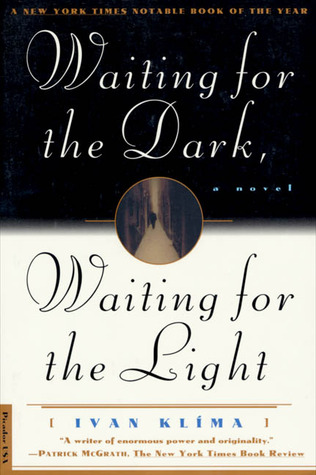
I read Waiting for the Dark, Waiting for the Light about a month ago but have delayed in writing this review because I found the book rather complicated and it required some reflection on my part. The story is set in Czechoslovakia during and after the velvet revolution of 1989. The protagonist, Pavel, is a middle-aged camera man who is living with his girlfriend, her son, and her ex-husband. As a young man, Pavel tried to escape his repressive regime but when we meet him, he is working for a state-run television network producing state sponsored propaganda news. In his spare time Pavel dreams about the movies he wants to make. The novel alternates between sections of Pavel’s real life and his life as imagined by the movies he wants to make.
I don’t want to say too much more about the plot so you can enjoy it for yourself. This was a pretty dark and bleak read but with humor injected throughout. There is a touch of surrealism throughout the book which makes it a more interesting read. Klima does a wonderful job capturing the atmosphere of ordinary people living in a repressive regime while at the same time blurring lines between the reality and fiction. I do have to admit that I was really confused for the majority of the book. It wasn’t until about 3/4 of the way in that I realized how the book was structured. This was a problem for me since the character names overlapped between versions with facts changing throughout. Even after realizing that parts of the book were Pavel’s imagined film, the boundaries were never crystal clear and had me questioning which events were real and which were imagined.
Another interesting element about this book was that it covered a period of transition between the old and new regime and it highlighted the feeling of being stuck between two different eras. His characters are trapped in a system that only allows for self-defeat. At one point the protagonist states:
The system never allowed you to win, and so it saved you from defeat as well.
Characters feel impotent and turn to dreams and fantasy in order to imagine how their lives could have been different.
Despite it’s rather complicated message, plot, and structure, it is a book that is easy to read and doesn’t feel overly dense (unlike many other Eastern European classics). I highly recommend this book, particularly for those readers who enjoy fiction with ties to political realities.
Additional quotes
A picture was a motionless record of motion. An arrested representation of life. A picture was the kiss of death pretending to possess immutability.
You can rule with a firm hand, or you can rule through consensus. Those with neither the strength nor the courage for firmness take refuge in the belief that they can remain somewhere in between. But that is an illusion.
Life is waiting for the light, not for the dark,’ she said. ‘My Indian teacher told me that. He was blind.’
It was like a spider’s web with a lot of spiders in it, not just one. They lay in wait for you at every corner of the web. Once you got caught in it you couldn’t get free. And they didn’t suck your blood right away, they’d just very slowly wind you into their web.
★ Hated it & no redeeming additional qualities noted. Recommend avoiding it.
★★ Disliked it, may have 1 redeeming quality (writing style, novelty, etc).
★★★ Liked it or may have a few interesting qualities.
★★★★ Really liked it & it has at least a couple interesting qualities.
★★★★★ Loved almost everything about it. Only a few, if any, minor limitations noted.
Book Worm’s rating system
★ Bah I really hated this would not even pass this to my worst enemy
★★ I really didn't like this but would consider giving it to my worst enemy for vengeful purposes
★★★ this was an enjoyable way to pass the time not great not horrendous
★★★★ really enjoyed this book there was something about it that made me think
★★★★★ wow I loved this book I am now out recommending it to all my friends, will keep to re read even though I have banned re reads




 by Margaret Mitchell. The names of our two contributors will be revealed after voting closes! Please make sure to vote for this month’s book even if you haven’t read the book! The poll is at the bottom of this post.


 jenp27
 Nicole Del Sesto


 The Reader's Room