2026 Booker Prize: May We Feed the King by Rebecca Perry
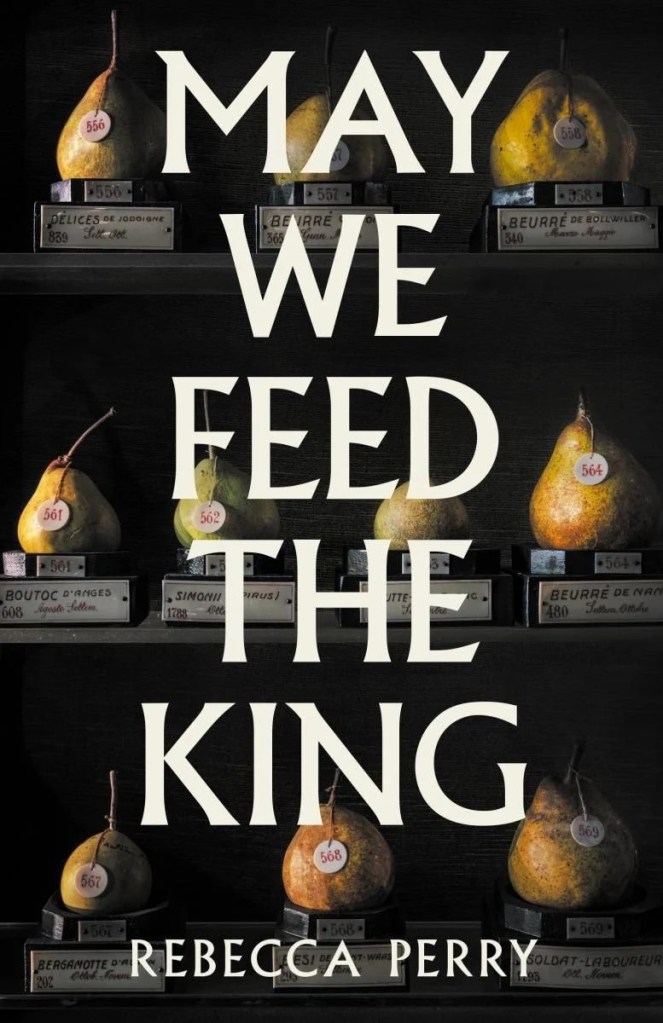
Next up for our panel is May We Feed the King by Rebecca Perry. Here are our reviews….
Rebecca Perry is a British writer and poet, best known for her acclaimed poetry collection Beauty/Beauty, which was shortlisted for the T. S. Eliot Prize. Her work is known for its imaginative, lyrical style.
Book Synopsis from Booker website: She is a curator, who spends her time dressing the rooms of historic buildings to bring them to life. But in the lush private quarters of a medieval palace, she finds herself so transfixed by the reign of an almost-forgotten King that the edges of her life begin to blur.
He is a reluctant ruler with no hunger for power, rushed to the throne after the untimely deaths of his older brothers. But it isn’t long before whispers begin to fly around the court. And with the growing belief that the King is not fit for the throne comes the idea that another might rule in his stead.
May We Feed the King dances between the lives of a historical subject who risks the future of his kingdom and a woman who turns to the past to hide from her present.
Jen’s Thoughts: I absolutely adored this book. Who knew I could find a book about staging fake food so compelling? The writing was so beautiful that I found myself completely transported and immersed in the times and places.
Of course, the book isn’t really about staging food, but rather an exploration of storytelling and the ways we use art and stories to recreate things that are inherently temporary and in some ways unknowable. I also loved the questions the book raises about what is real versus artificial, whose stories we preserve and how we create and recreate those stories. Perry’s novel explores ideas about history, memory, creativity, and the ways in which we reconstruct the past.
This was beautiful, thoughtful, and creative novel. I loved it. While I did love the book, I’m not sure whether it will be the sort of book I remember too much in a year or two – outside of the memory that the writing was outstanding.
Writing quality: 5/5
Originality: 4/5
Character development: 2/4
Plot development: 3/4
Overall enjoyment: 2/2
Total: 16/20
Tracy’s Thoughts: I loved the descriptions in this book! It was also something I haven’t thought about before- how do historians know for sure how to set the tables, the rooms, etc? In this way, it almost felt nonfiction- I assume the author did a lot of research. Yet she kept it interesting with characters with real thoughts and wants. I loved the relationship between the king and queen. It wasn’t perfect, but it was well-thought out and beautifully descriptive.
Writing quality: 4.5/5
Originality: 4.5/5
Character development: 3/4
Plot development: 3/4
Overall enjoyment: 1.5/2
Total: 16.5/20
Nicole’s Thoughts:
I enjoyed this a lot. I thought it was an original take on something which has been done (to death) – life at court. It was a well-done combination of life in the present and life in the past. History brought to life based on the (mundane?) documentation of the past. There’s a lot to think about in this short book – art, perspective, interpretation.
Writing quality: 4/5
Originality: 5/5
Character development: 3/4
Plot development: 3/4
Overall enjoyment: 2/2
Total: 17 /20
Lisa’s Thoughts: In May We Feed the King, the voice starts with a present-day narrator who is studying archival documents and the architecture of a palace in order to physically recreate a certain day in the history of the palace. This book then moves to the past — to a description of the events or the possible events or the gossip about events leading up to that particular day. Because the chapters are short, I found I could really slow down and savor the descriptions of how things like food or plants may have looked. This is important because this is exactly what the modern day narrator does – create a visual panorama of the past. In the book, the reader then sees/ reads how many different interpretations of the past can come from the necessarily limited documentation, and how, even at the time to which the archival documents refer, there are many different interpretations of what is actually happening. Coming back to the present day, the narrator finds a way of incorporating this uncertainty into their work of setting the visual stage, and in doing so, starts to heal from an unnamed trauma. It’s just so beautifully done.
Writing quality: 4/5
Originality: 4/5
Character development: 3/4
Plot development: 4/4
Overall enjoyment: 2/2
Total: 17/20
Rankings
1. John of John: 16.83/20
2. May We Feed the King: 16.63/20
3. The Things We Never Say: 15.3/20
4. Helen of Nowhere: 8.9/20
Have you read it? What do you think? Want to try it for yourself? You can pre-order your copy here: May We Feed the King


 jenp27
 Nicole Del Sesto


Wow, your list is getting interesting. I loved this book too, and picked it for the long list as my debut author choice. I haven’t started to put my books in an order yet, but I am sure this one will be on my ‘want to make it to the shortlist’ list… along with The Renovation (my favourite so far) and The Shadow of an Object.
LikeLike
I just finished this one – – my last read of the short list. The writing!!! This book is exquisitely written. Not a word out of place. Not sure it can win, but it won my heart.
LikeLike