The City and its Uncertain Walls by Haruki Murakami
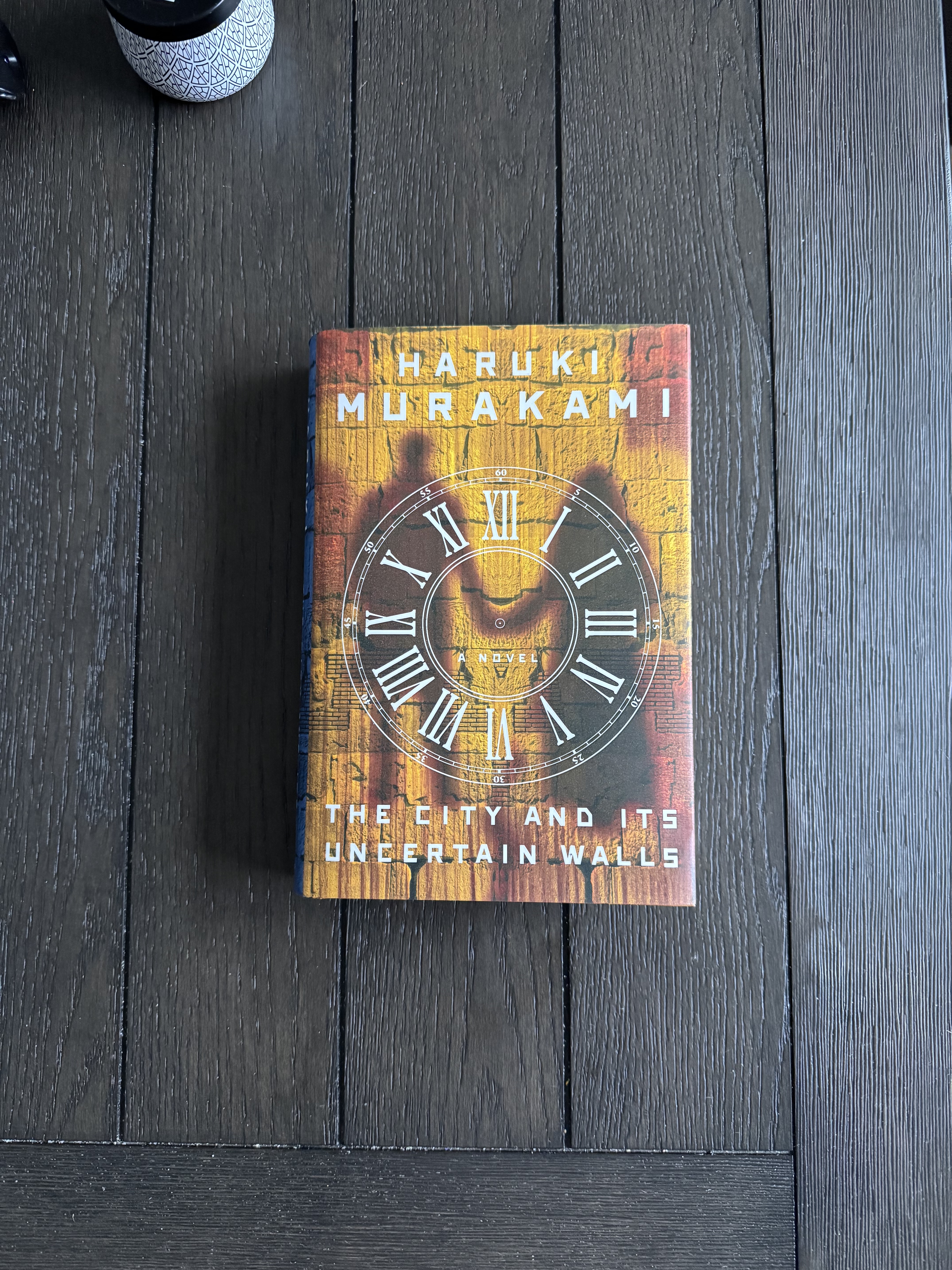
Those of you who have followed the blog for a while already know that Murakami is one of my favorite authors so it’s probably no surprise that I picked a Murakami novel as my first read of the year. 2024 was less than stellar for me from a reading perspective. Work burnout and life stress left me with little energy and motivation to read (outside of our Booker feature) and even less time. So I go into 2025 hoping for a better reading year and I always enjoy a good Murakami novel. Did this book live up to my expectation? keep reading to find out.
The City and its Uncertain Walls by Haruki Murakami
Translated by Philip Gabriel
Review: 3.5 stars
Buy your copy: here (amazon affiliates link)
Like any Murakami novel, the plot of this novel can be hard to describe. Told in three parts with intertwined threads, The City and its Uncertain Walls is the third iteration of a story that Murakami first wrote in 1980 and then revised into what became Hard-Boiled Wonderland and the End of the World. This latest work followed a break of 6 years and was written/revised during COVID-19 and you can see how the pandemic shaped the material.
The book is narrated from the perspective of the unnamed main character, a man in his mid-forties. Part one is the narrator’s account of his first, and possibly only, love who he met at a prize ceremony for a writing competition at age 17. The two meet, fall in love, exchange letters and at some point in their relationship, the girl discloses that her real self is far away in a mysterious city surrounded by a high wall. Together the pair build this mysterious city until the girl disappears without a trace.
A second narrative is interspersed within the love story in part one. In this narrative, the narrator who is now in his 40s finds himself inside the walled town where he encounters his girlfriend who is still the age when they fell in love. He has not seen her since she disappeared when he was a teenager. In this town he works as a “dream reader” in the town’s only library (where all the books are dreams). The city is without color, characterized by mundane routine and with a timelessness that is characteristic of some of Murakami’s other works. To enter the town, people must be leave their shadows outside the walls and once you enter the town, you cannot leave.
Parts 2 and three are the rest of the story that Murakami wrote for this novel and extend the original story that he wrote in 1980 These sections take place when the narrator has returned to the “real” world. In this world, the narrator quits his job and moves to a remote mountain town to work as a head librarian in the town library. And there, the narrator encounters a series of events and people that blur the lines between dreams and reality. In what is typical Murakami, the novel comes replete with ghosts, mysterious disappearances, odd characters, cats, jazz, and literary references.
If you are a fan of Murakami, you will likely appreciate this book. He packs a lot into the novel, but, I think a large part of my enjoyment was due to the fact that I picked out the motifs, recognized the nods to other works, and was able to make links between various other novels. Those readers who are less familiar with his works may not enjoy this book as much since it became a bit repetitive in parts 2 and 3. If you need neatly wrapped threads, you will likely hate the book. I read this with my partner (we do a joint read each month and this month was my pick and the category was Japanese fiction). He has never read a Murakami novel and as he was reading, he said to me “I really hope I get an answer for what happened with X.” Spoiler alert, you don’t. In fact you don’t get many answers and you are left having to sit with the ambiguity. I’ll add his rating to a comment once he is finished.
The City and its uncertain walls touches on themes human consciousness, reality vs. fiction, multiple selves, love and relationships. I ultimately enjoyed it but it’s probably not in my top half of his novels (you can read my ratings of this prior books: here). I think the themes have been done better in his other works. I did love reading the author note at the end that described the process for writing this book and how he felt compelled to extend the original story. Is it worth reading? If you are a fan of his work, then yes. If you are new to Murakami, it’s not a book I would recommend as a starting point.
As a quick aside, Murakami’s characters often navigate loneliness and isolation and lost love and the main character in this novel was no exception but I admit to fantasizing about how I could travel to an isolated mountain town in Japan and spend my days in a library drinking fresh brewed tea and watching library cats.
We want to hear from you: Have you read this book? What did you think? Feel free to share your reviews in the comments. Which is your favorite Murakami novel?


 jenp27
 Nicole Del Sesto


 The Reader's Room
You said it well that Murakami leaves you to “sit with the ambiguity.” I enjoy reading his books for that. For how they can feel like dreams. For the long conversations between characters about various topics that feel meaningful because the people are making connections. I don’t know if I have a favorite Murakami novel. Scenes from various books have stayed with me. From “Wind-Up Bird Chronicles” with the character spending time in a well, to the sadness of “Norwegian Wood,” to the library in “Kafka on the Shore,” to the husband and wife in “The Second Bakery Attack” (a short story). To several more 🙂 He crafts wondrous stories that I can get immersed into.
LikeLiked by 1 person
I was super interested to read your review of this.. I haven’t read much about it (but have noticed it a lot as I love the Hardback Australian Cover). However, it also featured in the Literary Hub’s most scathing reviews of 2024. The review has similar frustrations to yours but perhaps wasn’t as connected to Murakami as you, and maybe, it sells more papers to be scathing 🙂
I hope you are feeling better and that 2025 holds much more balance and joy
LikeLiked by 1 person
Oh, that’s sad to hear. I’ll have to read their review. I did enjoy picking up on some of the threads linked to other works and a book set mainly in a library can’t be all bad. This felt a little like a blend of Norwegian wood and colorless (both of which I loved) but not as well done.
LikeLike
My partner’s review
4 stars overall
I found the book very interesting, a solid but also at times very confusing read.
I found myself glued to some chapters, just to feel like i went 2 steps back due to the writing and repetitive storytelling at times
This was my first time reading this author’s work. I was left with some questions in the end. At the same time my own mind filled in the blanks for some of those questions. it is certainly a book that engages with the reader, and you feel that you are close to the main character. i at times could relate to the feelings he had and how he experienced the world.
All in all, a solid good read on the beginning of the year
LikeLike
I’m actually very surprised he liked it so much. He had not read my prior works and I don’t think he’s read much magical realism either. We had an interesting discussion about some of the themes and he had some interesting speculations about the role of the boy and what the two worlds represented
LikeLike